


Article Index
5.1. Genetic modification techniques
5.1.1. Classical methods
The classical methods for genome modification of microorganisms are divided into two types:
- Selection of mutations arising spontaneously and induced by different physical and chemical factors of the environment. The spontaneous mutations are consequence of rearrangements in the heritable DNA molecule due to substitution of one nucleotide with another, the addition or deletion of one or more nucleotides or other types of reformations. A lot of spontaneous mutants arise due to the movement of transposable elements to new locations in the double strand DNA. Such kinds of elements are typical for plants, animals and microbes.
- Exchange of DNA between closely related organisms. This type of gene modification in microorganisms concerns introduction of new genetic information by chromosomal or plasmid DNA. This event happens when DNA from the chromosome of the donor microorganism is integrated into DNA of the recipient one. Being self replicating, plasmids transfer the DNA of the donor into recipient without integration with chromosomal DNA. Thus, plasmid DNA can be transferred to widely divergent organisms compared to the donor ones. The movement of the plasmid could be easily observed because of the marker borne by its molecule (for instance antibiotic resistance). Three different classical types of gene transfer are characteristic of bacteria. It is considered that these three mechanisms occur naturally:
- DNA-mediated transformation (DNA is transferred as “naked” DNA)
- Transduction – transfer of DNA is mediated by a virus
- Conjugation – DNA is transferred during cell-to-cell contact between donor and recipient cells.
5.1.2. Molecular techniques
Recent molecular technological advances in mutagenesis and gene transfer methods expanded considerably the range of microorganisms into which DNA from unrelated organisms can be introduced. The genus barrier and the kingdom barrier are no longer insurmountable obstacles.
Current methods used in bacteria allow the inserted gene recombinant constructs to be integrated at specific sites into the chromosome or the plasmids. Nevertheless, the procedures for gene modification should be subjected to safety considerations. The following important features are a matter of discussion: peculiarities of the host microorganism in respect to inserted gene(s), characteristics of the vector and construct; DNA transfer methods.
When bacteria are used as host microorganisms a procedure for safety assessment requires a history for safe consumption of this microorganism either as a food or as a food component. If this evidence lacks, the safety of the host must be established. For the eukaryiotic host the same safety considerations are applied.
The inserted gene(s) could be taken from the same microbial species or from evolutionary more distant organism. The inserted gene products should have a history of safety use in food or its safety should be substantiated. The shorter the inserted DNA fragment, the more reduced/facilitated the procedure for evaluation of food safety would be.
As regards the characteristics of the vector and the construct - if the vector used is a part of the genome of GMM the whole DNA sequence should be characterized including; replicons, promoters, selective markers, linkers as well as any other parts of DNA. The vector must contain nucleotide sequence from microorganisms with history of safe use in food. The selective markers must be selected very strictly and based on safe use and the antimicrobial resistance marker must be avoided. In case of use, an application of specific methods for removal from GMM genome should be applied (e. g. sequence specific recombination). For the eukaryotes specific cloning vectors like centromeric plasmids, yeast artificial chromosome, plasmids based on killer factor determinants etc. have been designed.
Speaking about DNA transfer methods - recommendation exists for use of methods of DNA transfer of physical, chemical and biological nature, which minimize major genetic rearrangements in host genome. In case of use of integrative vectors, the nucleotide sequence of the flanking regions at the integration site of the chromosome should be characterized. This information is necessary to predict the risk of the methods used. In eukaryotes there are dependable methods for directed integration of in vitro modified or composed gene constructs into specific chromosomal sites and for deletion of genes applicable in certain species. On the basis of these methods, transgenic constructs have been made and they are highly stable during vegetative growth of cells. A possibility of recombination by mating with related strains of indigenous microflora exists. When the genetic properties of the used strains are not well known, the insufficient information about possible recombinant events makes it impossible to forecast the mechanism and integration site of the foreign genes. Thus, it is possible the methodology used in genetic manipulation of yeasts and filamentous fungi to enable integration at variable sites, which could cause appearance of different biotechnological properties and genetic stability of GMMs.
5.1.3. Comparison of classical and molecular approaches
The terms “classical” and “molecular”, regarding the methodology of genetic modification of microorganisms, as it was already mentioned, concerns enhancing their genetic variability. This effect is achieved using classical methods by spontaneous or mutagen induced variation, by hybridization or gene transfer. These methods are inaccurate and none directed, less powerful in comparison to the molecular ones for gene modifications. But there is no doubt that there is no conceptual distinction between genetic modification of microorganisms by classical or molecular techniques which cause DNA modifications and gene transfer.
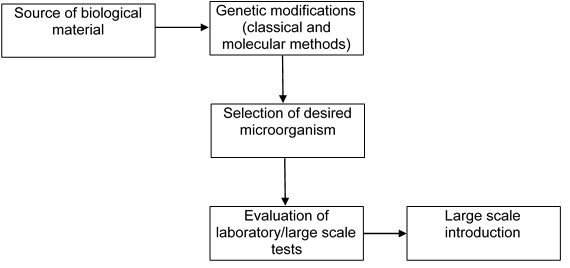
Fig. 1 shows the genetic modification of microorganisms and pathway for introduction into environment. Here both methods are unified in sense that it is no matter classical or molecular breeding methods at the steps of evaluation in laboratory, field or large scale environmental introduction are applied.
Figure 1
The underlying biological principles characterizing this concept were implicated in the EFSA reports:
- The primary focus for decision making about the introduction in the environment is the product obtained by genetic modification and selection, not the process itself.
- The characterization of the product needs information about the process used. But the nature of the process is not a sufficient criterion to decide whether the product should be more or less overseen.
- The responses of the microorganisms modified by molecular or classical methods are based on the same physical and biological laws. The accumulated knowledge about products of classical modifications could be applied on product obtained by application of molecular techniques in terms of relative safety and risk assessment.


