


Article Index
4.2.5. Phytoremediation
Phytoremediation is a bioremediation technique that uses various types of plants and associated microorganisms to remove, transfer, stabily, and destroy contaminants in the soil, sludge, sediments, wastewater, groundwater and air. Plants are able to indicate, exclude, accumulate, and hyperaccumulate or metabolise toxic inorganic or organic substances. Thereby they contribute significantly to the fate of chemicals, and they can be used to remove unwanted compounds from the biosphere. Phytoremediation offers an environmentally friendly, cost effective, and carbon neutral approach for the cleanup of toxic pollutants from the environment. The advantages and disadvantages of this technique are given in Table 4.5.
Phytoremediation mechanisms involve phyto-extraction, phyto-stabilization, phyto-volatilization, phyto-degradation, phyto-accumulation, rhizofiltration, rhizosphere biodegradation, and hydraulic control. These mechanisms are shown in Figure 4.1.
Phyto-extraction
Phyto-extraction uses plants or algae to remove contaminants from soils, sediments or water. In this mechanism, plants remove heavy metals or radionuclides from soil through their root system and accumulate them in the root or transport them up into shoot or leaves. Plant may continue to remove contaminants until it is harvested. After harvest, if the contaminated soil does not reach significant cleaning up level, the growth/harvest cycle must usually be repeated through several crops to achieve a significant cleanup.
The main advantage of phyto-extraction is being environmental friendly. It does not cause any harm to soil quality. Another benefit of phyto-extraction is that it is less expensive than any other clean up process. As this process is controlled by plant, it takes more time than any traditional soil clean up process.
Phyto-stabilization
In this mechanism, the plants immobilize the contaminated chemical compounds from soil and water. Contaminants are taken up by roots and precipitated in the rhizosphere. This prevents the contaminant getting into food chain.
Phyto-volatilization
In this mechanism, water containing organic contaminants is taken up by plants, and the contaminants are released into the air through by their leaves. The contaminant may become modified along the way, as the water travels along the plant's vascular system from the roots to the leaves, whereby the contaminants evaporate or volatilize into the air surrounding the plant.
Phyto-degradation
In this mechanism, contaminants (organic) are metabolized and destroyed within plant tissues. These smaller pollutant molecules may then be used as metabolites by the plant as it grows, thus becoming incorporated into the plant tissues.
Phyto-accumulation
In this mechanism, contaminants along with other nutrients and water are taken up by plant roots. This contaminant mass is not destroyed but accumulate in the plant shoots and leaves.
Rhizofiltration
This mechanism uses both terrestrial and aquatic plants to absorb, concentrate and precipitate metal from contaminanted water (surface or groundwater).
Rhizosphere biodegradation (Rhizodegration)
In this mechanism, plants relief common substances through their roots, supplying nutrients to microorganisms in the soil. So the microorganisms enhance biological degradation. For instance, plant root exudates carbohydrate sources (sugars, alcohols, and organic acids) for the soil microflora. These compounds enhance microbial growth and activity, and also they act as chemotactic signals for microbes.
Hydraulic control
In this mechanism, contaminated ground water is remediated by trees.
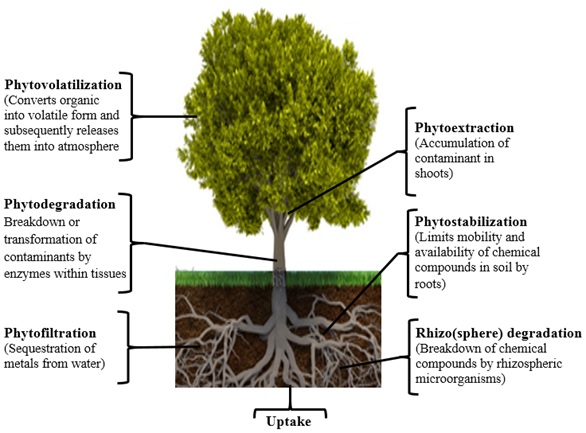
Figure 4.1. Phytoremediation mechanisms
Table 4.5. Advantages and disadvantages of phytoremediation technique
| Advantages | Disadvantages |
|
• Phytoremediation is less expensive than the old "pump and treat" method for the treatment of contaminated water. • Phytoremediation is also much less expensive than digging out the contaminated site. • Up to 95% of TCE present in water could be removed by simply planting trees and letting them grow. • Phytoremediation takes no maintenance once instituted. • Since phytoremediation uses plants, it is aesthetically pleasing. • After plants are introduced, wildlife is able to flourish at the once uninhabitable site. • Solar energy is used to drive the cleansing activity. |
• Phytoremediation is limited to sites with lower contaminant concentrations. • Phytoremediation is restricted to sites with contamination as deep as the roots of the plants being used. • The food chain could be adversely affected by the degradation of chemicals. • The air could be contaminated by the burning of leaves or limbs of plants containing dangerous chemicals. |


